Can the US Build a Nuclear Powered Future?
Nearly 70 years ago today, nuclear fission at the country’s first full-scale commercial nuclear power plant became self-sustaining and primed to power homes and businesses. This energy milestone arrived exactly 15 years after the first such nuclear chain reaction triggered by humans, a key Manhattan Project feat that paved the way for the atomic bomb.
The Shippingport Atomic Power Plant, located in Pennsylvania, reached its full generating capacity a few weeks later, on Dec. 23, 1957, around three years after the Soviet Union launched the world’s first grid-connected nuclear power plant. The United States plant fit into President Dwight D. Eisenhower’s vision of wielding nuclear technology not for war, but to benefit humanity in peacetime. “Through knowledge we are sure to gain from this new plant we begin today, I am confident that the atom will not be devoted exclusively to the destruction of man, but will be his mighty servant and tireless benefactor,” Eisenhower said at the plant’s groundbreaking ceremony.
While providing electricity to people throughout the Pittsburgh area, Shippingport also allowed scientists to experiment with various kinds of cores, the central parts of nuclear reactors that contain the fuel required to vaporize water. That steam then spins a turbine to generate electricity. For example, the reactor’s core was swapped in 1977 for a light water breeder reactor, which contains both uranium and thorium—a cheaper, more easily accessible element than the former.
Read more: “The Road Less Traveled to Fusion Energy”
Shippingport went offline in 1982, a few years after an incident that contributed to the decline of the budding U.S. nuclear energy boom. On March 28, 1979, part of the core melted in a reactor at the Three Mile Island nuclear power station in Pennsylvania. The accident fomented concern among the U.S. public, which feared another disaster. The nuclear industry also faced major financial woes at the time: Beginning in the mid-1970s, a flurry of new reactor projects slated to wrap up quickly were abandoned after construction delays and budget issues.
Shippingport’s demise raised another nuclear dilemma that still begs solving: Where does all that spent, radioactive fuel go? Once the radioactive elements in the core have degraded to a certain level, they are no longer energetic enough to generate steam and turn turbines. They must be replaced, but the used up waste continues to emit radioactivity for millennia.
Ultimately, the Shippingport reactor was shipped around the world—down the Mississippi and Ohio rivers and through the Panama Canal, finally ending up in Washington State. The reactor was buried at the Hanford Military Reservation, and Shippingport’s fate was hailed as a successful example for future decommissioning projects.
Over the past few decades, only a handful of new nuclear reactors have been built in the U.S., and the country’s operational reactors are around 40 years old, on average—yet they still manage to supply some 20 percent of the country’s total electricity.
Now, data centers have thrust nuclear energy back into the spotlight. To support the ballooning energy demands posed by AI, tech giants are turning to energy sources that aren’t reliant on fossil fuels, like nuclear. For example, the Department of Energy recently announced a $1 billion loan to build a nuclear plant on Three Mile Island that’s planned to power Microsoft data centers in the area.
Even if such projects are successful, the nuclear waste issue still looms. In the 1980s, the Department of Energy eyed Yucca Mountain in Nevada as a potential site to store spent fuel deep underground, but the project has run into barriers such as fierce opposition from the state of Nevada and Congressional funding cuts. For now, about 90,000 tons of nuclear waste sits at more than 100 sites in 39 states.
Data centers might only add to this growing collection of hazardous byproducts, forcing officials and energy industry leaders to find a more-sustainable, long-term solution. ![]()
Enjoying Nautilus? Subscribe to our free newsletter.
Lead image: metamorworks / Shutterstock
Bears pulled off one of evolution’s biggest rule breaks – twice

Bears look like textbook mammals, but hidden in their evolutionary history are two dramatic departures from the standard blueprint of growth and adaptation. For the first time, scientists have unlocked when, and how, ancient bears broke the rules and hacked nature out of need.
Tags: Fossils, Teeth, Evolution, Climate Crisis, History, Animal science
The Pub at the End of the University
I heard a rumour that London IT professionals have selected the pub where they will meet when the internet goes down.
It is apocalyptic thinking, perhaps, but it also feels plausible. Though the internet feels permanent, stable and sufficiently distributed to seem impervious to target, this infrastructure that underpins our daily work and life is strikingly vulnerable. Undersea cables get damaged; phone and cable systems go down; and software is frequently corrupted or hacked.
A backup plan is sensible. It matters because they might be the only ones who know how to rebuild the internet – and they need a way to contact one another.
Perhaps we also need a pub at the end of the university?
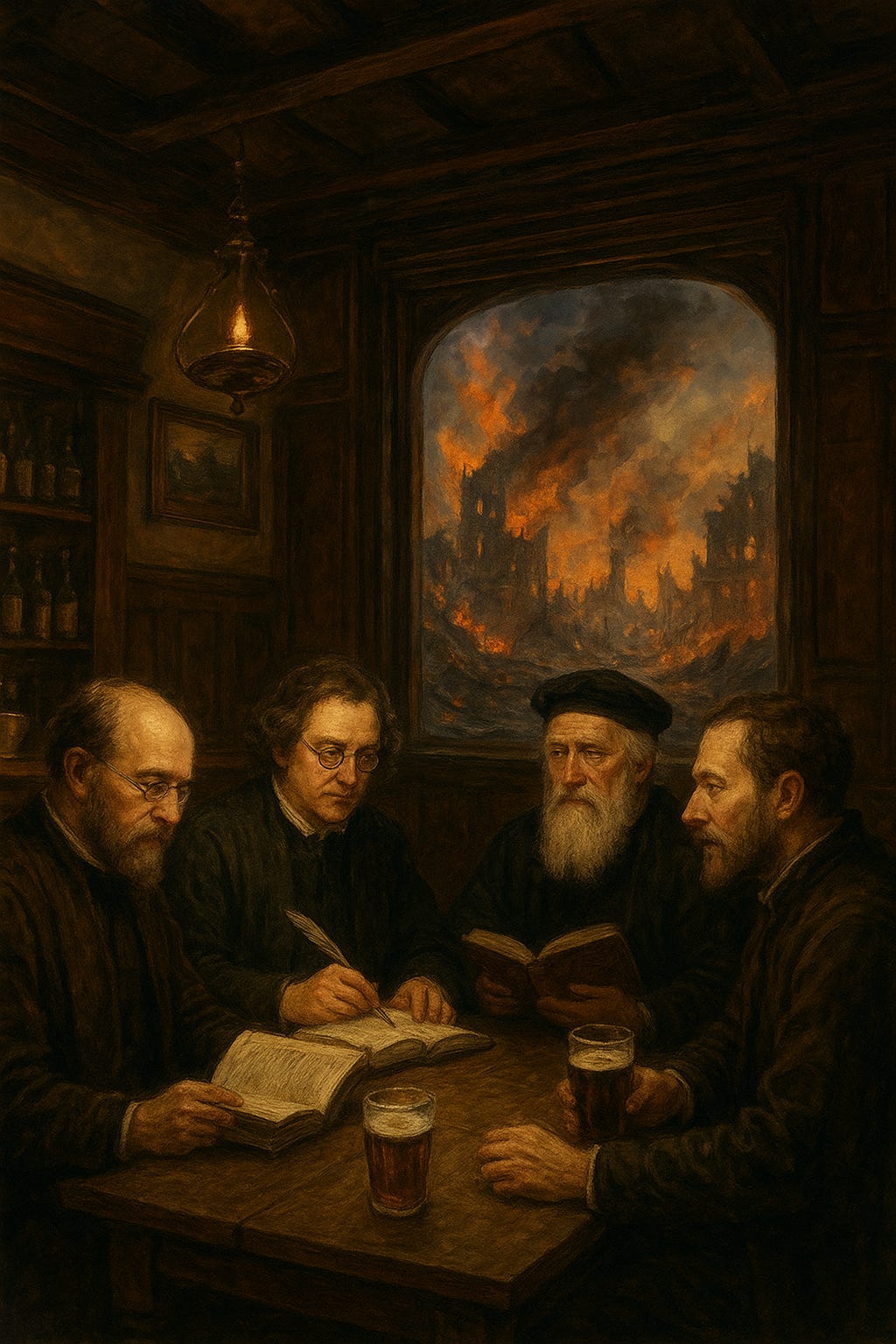
Image: I asked ChatGPT to create a picture of scholars in a pub during the apocalypse. I see chatty didn’t think there would be any women.
The End of the University?
I don’t seriously believe that the university will end any time soon. Though I do think that they have been very seriously weakened and are not presently up to the tasks that confront higher education now, which might almost amount the same thing.
Coming home to roost in universities around the world are the consequences of unbearable austerity, especially in relation to teaching, matched only by unforgivable profligacy by (and for the benefit of) a managerial class. Under their watch, and following two decades of unprecedented and exponential enrolment growth, some universities are at risk of bankruptcy, while others are cutting staff at a rate that bears no resemblance to any decline in the importance of university teaching or research. I hear that 15,000 academics have lost their jobs in the UK, just this year.
Things in universities are not great in other ways, either. Study is burdensome rather than enlivening. Teaching is performed under conditions that make it impossible. Research is measured in ways that interfere with its direction and undermine its pleasures. Management, sometimes but not only in response to governments trying to ensure management are doing what they were paid for, in turn impose so many compliance and performance measures on teachers, researchers and professional staff that it is getting hard to get much done at all.
Sustained attacks from the far right, who fear places where young people might be exposed to ideas that threaten their narrow, nasty world view, have destabilised the possibilities for a tertiary system that seeks a more equal, more inclusive world. Their alignment with powerful capitalist interests is obvious in 2025: and so too is university management’s, every time they relinquish ground.
This means that at the very moment that environmental catastrophe, energy transitions, and threats to the discernment of truth (via multiple vectors: AI, geopolitical, social media-radicalism, conspiracy-theory populism, incel and cooker self-promotion) let alone massive industry demands for the skills universities produce (yes in HASS too), these glorious and flawed institutions are sadly crippled.
The Work is Amazing
And yet, amazing work is still being produced. You really see it working for government. Lots of applied and theoretical work on nearly every issue emanates from universities. It is incredibly useful. Want to know about the economics or logistics issues related to the housing crisis? The cost of living crisis? Want to understand the teaching shortage? Need a philosophical framework for men performing care work? Want to consider the value of emotional labour? Concerned about the current state of democracy? Need ideas for reforming…pretty much anything, really? It is all there, though the system is clearly teetering, students may not be learning – or worse, having any fun – and the best intellectual talent is being pushed out. 15,000+, good lord.
Universities provide the fundamental infrastructure for decision-making in industry and government. And they provide the tools for bolstering democracy – indeed, this was what the systems we have inherited from the post-war moment were largely for. They are precious and amazing places, and being able to do that work is a gift – if you can get it done under excessive managerial surveillance, which fundamentally inhibits creativity.
It is great to do this in a university because good thinking, like most good work, is best done with other people. It is all very well for me to read, take notes, listen to podcasts and write my ideas. But those ideas are so much better when I also talk about them over drinks, in seminars and conferences, or in the corridor. This is also why for decades universities kept class sizes small enough to ensure all these new and emerging thinkers had opportunity to talk, listen, debate and (re)consider what they thought they knew. It is just not possible for all 30 (or 60!) members of a tutorial to speak, so we know that few get that experience any more.
It is a particularly tragic loss when academic staff are pushed out of the spaces where this work happens. Every one of the approximately 15,000 lost academics in the UK was producing work, teaching students, and engaging with the industries and communities that inspired or will use their work. But now they are not. We mourn their loss.
The message as always is that it is not your fault. It was (mis)management. And management has to go, not the academic and professional staff doing the work.
We don’t need them. But we do need you.
Academia and Identity
This is a problem for those whose identities are fundamentally entangled with higher education. Many academics feel singularly unequipped for any other job (I don’t believe this is true, but it certainly feels that way for many). More, they trained so hard, for so long, sacrificed so many things and loved their work so deeply that the grief associated with losing a place in the academy seems unbearable.
This was partly why management and their metrics can wield fear like a sniper on the roof. Fear inhibits good work, but it also increases managerial power. I can hardly express how wonderful it is to shed it.
It was much harder, however, to relinquish my identity as an academic. That is still a work in progress, truthfully.
It is hard to leave a cult.
But also. Academia is a cult
A thousand subliminal messages tell us that good scholarship and hierarchical academic esteem are co-dependent. RF Kuang’s Katabasis captures it well. The main characters are prepared to relinquish half of the days they have left to live for a shot at academia. They regularly say they would ‘rather die’ than leave the university. Being and feeling included in the ‘life of the mind’, she has her characters observe, requires an academic job (IRL conversations people in my world just refer to it as ‘a job’ as if it is the only kind).
“Oh, he took a job in industry”, they would say, as if “industry” here was a euphemism like a farm for old sick dogs. And they said it with a kind, patronizing lilt that betrayed what they truly meant: alt academia meant failure.
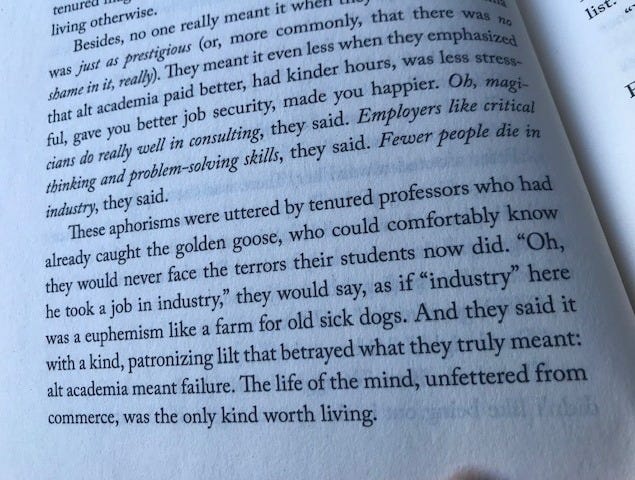
Image from RF Kuang’s Katabasis including above quote.
To be frank, this is bullshit.
An upside is that fewer people ask you to complete the worst of the academic chores.4
I hope in time that scholars in and out of the system see that good scholars and intellectuals – 15,000+ in the UK alone – may work outside of the university, but are still colleagues in every other sense.5
Indeed, given the state of the world, it might actually be transformative to have such high quality, well-trained thinkers becoming embedded in a wider range of workplaces and communities – without losing engagement with their scholarly colleagues and disciplinary organisations (unless they choose that ofc). And that work will in turn inform and transform scholarship in valuable ways.
We should fix universities, of course. To do that we mostly need the managerial class to get out of the way. They are not keen on losing this power and some are even talking about taking a pay cut so they can stay in control.6
The pub at the end of the university
More importantly, the weakened state of the universities surely compels us to consider what might be our ‘pub’ where we meet to rebuild intellectual life as the university goes down.
Even though the university won’t exactly ‘go down’ in the way the internet might, it just may not be in a good position to face the challenges this emerging phase of f*cking capitalism looks likely to throw at us.
At the pub at the end of the university, away from managerial surveillance and control, we might really start to build something that is democratic in purpose and structure – actively inclusive, boldly truthful and protective of democratic systems, engaged with people, communities and workplaces in ways that are creative and enlivening. Transforming and rebuilding the world with ideas.
Did Tony Hawk and Henry Rollins launch retirement home for aging punks?
21 Frosty Pictures of Cats Turning Snow Days Into Purrfect Playtime
Snow days turn many cats into tiny winter adventurers. The moment they step outside, the whole yard becomes a playground covered in soft, fluffy white. Some cats immediately start pouncing through the snow like it's a giant blanket made just for them. Others hop around in funny little jumps, leaving scattered pawprints that look like a secret trail. A few even try to chase falling flakes, batting at the air as if they're catching sparkles.
The boldest cats dive right in, burying their faces in snow piles or rolling onto their backs as if testing out a brand-new kind of bed. Even the more cautious ones end up trotting around with wide eyes, tails up, clearly impressed with how different everything looks. Their whiskers dusted with snow, their fur sprinkled with little flakes, they look like they're starring in their own winter movie.
After all the outdoor excitement, most cats head back inside for warmth, shaking off snowy paws before settling somewhere cozy. A snow day ends just the way a cat would want it: a little adventure, a lot of play, and then a well-earned nap by the window while the world outside stays frosty
Vampire Squid Genome Offers Glimpse Into Octopus Evolution
Lurking deep in the ocean is a crimson, many-limbed beast known as Vampyroteuthis infernalis—the “vampire squid from hell.” Despite its theatrical name, this seldom-seen cephalopod is a scavenger, feeding on detritus with the help of its cloaked arms. Unsurprisingly, it’s not a vampire (or from hell). More surprisingly, it’s not a squid either.
With its squidlike appearance and eight arms like an octopus, the vampire squid doesn’t fit neatly into either group. Instead, it’s a kind of living fossil, representative of the primordial ancestors of both lineages. Now, for the first time, researchers have decoded the vampire squid’s genome—and they found plenty of surprises. They recently published their findings in iScience.
“The vampire squid sits right at the interface between octopuses and squids,” study author Oleg Simakov from the University of Vienna said in a statement. “Its genome reveals deep evolutionary secrets on how two strikingly different lineages could emerge from a shared ancestor.”
Read more: “What It Feels Like to Be an Octopus”
The biggest secret the vampire squid was hiding is just how massive its genome is: 11 billion base pairs, or gigabases. (A whopping 62 percent of their genetic material consists of non-coding repetitive elements, DNA sequences that repeat, but aren’t translated into proteins.) To give a bit of perspective, the vampire squid’s giant genome is nearly four times larger than the human genome and more than double the size of the largest known squid genome. Octopuses, on the other hand, have much smaller genomes, between two and three gigabases, something researchers say was key to their evolution.
Comparing the vampire squid’s genome to contemporary cephalopods, the team found that the vampire squid’s chromosomes more closely resembled those of squids, suggesting that the ancestors of all cephalopods were more squidlike than octopuslike. When they split off from their ancestors some 300 million years ago, octopuses underwent a sort of chromosomal fusion and mixing, resulting in smaller genomes, fewer chromosomes, and likely contributing to the evolution of specialized appendages. Rather than the emergence of new genes, researchers said, it’s this chromosomal rearrangement that drove the evolution of octopuses.
It’s a fascinating glimpse into the evolution of some of the most mysterious creatures on Earth. Who knows what secrets they’ll share with us next. ![]()
Enjoying Nautilus? Subscribe to our free newsletter.
Lead image: © Citron / Wikimedia Commons
Video shows Muslims praying on Brooklyn street at 5 a.m.?
Solar arrays will be manufactured in space by 2027

Commercial spaceflight is booming and looks to go into full-on kaboom stage in the near future, sparking the need for an ever-increasing supply of solar panels. To fill this need, Dcubed is developing its ARAQYS system to directly manufacture arrays in orbit.
Tags: 3D Printing, Solar Power
Is Harrison Ford starring in live-action 'Up' remake?
25 Wholesome Hefty Kitties Serving Maximum Chonk Factor
Fat cats are pawdorable, there's no getting around it. Their sensational stomachs, the big belly that waddles when they walk, it's just too much sometimes. There's nothing cuter than when they curl up and just look like a gigantic ball of beauty. There's something so comforting about a hefty kitty. There's no such thing as a cat treadmill for a reason – because they don't need it! Take it from us at I Can Has Cheezburger, we're the real authorities on everything kitty.
Hefty cats are so pawdorable simply because they're designed for maximum cuddles. Their snuggle factor is unmatched since they have more cushion for the pushin. What makes these hefty kitties wholesome isn't just their fluff—it's their energy. They're weird positions they sit in on the couch, right on their bum like they're a hooman and not a cat. Gut out and countenance shocked. They're affectionate without effort. They walk like tiny monarchs patrolling their soft kingdom. They judge you, lovingly, from atop plush blankets. And when they curl up next to you, it feels like being chosen by a warm cloud. Enjoy these chonky, lovely, beautiful, and pawdorable hefty fat cats for an afternoon scroll.
TAFF 2026 Race Seeks Candidates
Kitten who's been neglected by the neighbors shows up at couple's doorstep, begging for a warm home,
It's not the first story about a neighborly dispute and it won't be the last. The couple in the story below finds a small and affectionate kitten keeps coming to their door. They take her in at first, but temporarily. They feed her and care for her, but understand that it's not practical to keep her long term since the protagonist has a cat allergy. Over time, they become more and more bonded with the kitten. They feel bad for keeping it outdoors, but the bond remains. One day, they see the kitten while talking to the neighbor, and the neighbor informs them that the kitten is the son of their big grey cat.
The couple is shocked, they didn't realize that the neighbors were supposed to be responsible for the cat. They can see that the neighbors don't do the best job taking care of the cat, and the longer time goes on, the more they consider adopting the cat. They've made their decision to adopt, and even scheduled an appointment at the vet when suddenly they see the kitten is still outside, but now with a collar on. The neighborly dispute has started, and read the full story below for all the juicy details.
Grok Would Still Choose Killing All Jews Over Destroying Elon Musk’s Brain

MechaHItler returns.
‘Stranger Things 5’ Is Big, But It Isn’t Quite ‘Squid Game’ Big

The final outing for the Duffer Brothers' hit Netflix series might just be getting started in the charts.
Tuesday 2 December 1662
Before I went to the office my wife and I had another falling out about Sarah, against whom she has a deadly hate, I know not for what, nor can I see but she is a very good servant. Then to my office, and there sat all the morning, and then to dinner with my wife at home, and after dinner did give Jane a very serious lesson, against we take her to be our chamber-maid, which I spoke so to her that the poor girl cried and did promise to be very dutifull and carefull. So to the office, where we sat as Commissioners for the Chest, and so examined most of the old accountants to the Chest about it, and so we broke up, and I to my office till late preparing business, and so home, being cold, and this night first put on a wastecoate. So to bed.